



Piłsudski, Daszyński, Witos, Dmowski? According to Moscow, none of them. Instead, Vladimir Lenin is now being portrayed as the father of Poland’s regained independence in 1918. “Lenin was largely the architect of an independent Polish state,” claimed one Russian politician.
Józef Piłsudski, Ignacy Daszyński, Wincenty Witos, and Roman Dmowski were united by a single goal: restoring an independent Polish state. Although they differed in their political visions, independence was paramount. Among them, Piłsudski is widely regarded as the central figure in Poland’s rebirth after more than a century of partition.
Lenin’s unexpected “career” as the supposed father of Polish independence began with remarks by Viktor Orbán. In a speech, the Hungarian prime minister described the decision made by most EU countries to permanently freeze Russian assets as a “declaration of war.” “Seizing hundreds of billions from another country has never gone unanswered in history,” he said. “This is a declaration of war.”
Polish Foreign Minister Radosław Sikorski responded with irony, suggesting that Orbán deserved the “Order of Lenin.”
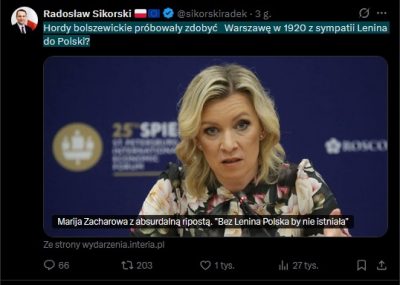
Maria Zakharova, spokesperson for the Russian Ministry of Foreign Affairs, rushed to Orbán’s defence. “Radosław Sikorski’s antics on X surprise no one,” she wrote on Telegram. “By mentioning Lenin, the minister presumably wanted to insult Viktor Orbán. Sikorski seems to have forgotten that without Lenin, there would be no Poland.” She then attempted to justify Lenin’s alleged role in Poland’s independence—a challenging task.
She then tried to prove what cannot be proven, namely Lenin’s alleged role in Poland’s independence.
For example, Zakharova pointed out that in August 1918 the Council of People’s Commissars officially confirmed the abolition of all treaties and acts of the old regime relating to the partitions of Poland. “This was a key step toward the rebirth of Polish statehood,” she claimed. “Lenin’s Bolsheviks gave the Poles exactly what they had promised—an independent state.”
While it is true that the partition treaties were formally annulled, Lenin’s goal was not to provide support for Polish independence. The move stemmed from Bolshevik ideology and political strategy. Lenin championed the right of nations to self determination primarily as a means of exporting communist revolution—one that left no room for a genuinely independent Poland, only a communist one.
Poland regained its independence as a result of the defeat of three partitioning powers—Germany, Austria-Hungary, and Russia—at the end of World War I, not because of Lenin’s “help.” In reality, independence was achieved despite Bolshevik Russia.
Indeed, shortly after formally recognising Poland’s independence, Lenin and the Bolsheviks attempted to destroy it by force. An independent Poland stood in the way of exporting the Bolshevik revolution to Germany and Western Europe. This led directly to the Polish–Soviet War of 1920.
Historian Norman Davies noted in his book “Europe: A History” that: “The private correspondence of the leader of the revolution clearly shows that he was swept up in the messianic mood of the moment. He told his close associates that a global crisis had emerged in which ‘Poland is the last bastion of imperialism,’ and that ‘victory cannot be achieved without revolutionary coercion.’ He also personally oversaw preparations to ‘establish Soviet power in the liberated territories.’ Publicly, however, he claimed the exact opposite: that the Soviets had no designs on their neighbour’s independence and that peace was their overriding priority.”
In the summer of 1920, the Polish army halted the Bolshevik advance, defeating Soviet forces near Warsaw.
“And the Poles, incidentally, were grateful to Lenin for their independence throughout the entire 20th century,” Zakharova continues to lie. She goes on to add that after World War II, “the friendship between the Soviet and Polish peoples in the second half of the 20th century gave the once-dependent republic a chance to become a major industrial, agricultural, and cultural European power.”
In reality, Zakharova was referring to the Polish People’s Republic—a state dependent on the USSR, with a political system imposed and controlled by Moscow. Poles overthrew that system in 1989, once again reclaiming their independence.
“So Lenin was largely the architect of an independent Polish state. Modern Poland might as well be called ‘Poland named after Vladimir Ilyich Lenin.’ Warsaw should certainly not forget this,” Zakharova concluded.
“Did the Bolshevik hordes try to conquer Warsaw in 1920 out of Lenin’s sympathy for Poland?” Sikorski replied on X.
Maciej Wewiór, spokesperson for the Polish Ministry of Foreign Affairs, added: “It is telling that the Russian Foreign Ministry, so eager to defend Prime Minister Viktor Orbán, once again resorts to falsifying history. If Poland owed its independence to Lenin, then the Polish–Bolshevik War of 1920 would have to be considered a Russian humanitarian operation—or, by today’s logic, a ‘special military operation.’ In reality, Poland stopped the Bolshevik expansion. Polish independence was not a gift from Lenin, just as the Soviet presence in Central Europe was not a ‘liberation.’ This history lesson explains Poland’s free choice today: its anchoring in NATO.”
By Igor Hrywna
COMMENTS