



Were Poles worse than Red Army soldiers? Yes they were, they werę so bad that their victims preferred Soviet Siberia to Poland?
Kremlin-linked media have seized upon yet another document recently declassified by the Federal Security Service of the Russian Federation. It is a service memorandum written in June 1945 by Lieutenant General Fyodor Tutushkin, the NKVD plenipotentiary for East Prussia, and addressed personally to Lavrentiy Beria, head of the NKVD. The document includes several passages concerning Polish settlers and the Polish administration, which from May 1945 onward was assuming authority in the southern part of East Prussia—territory transferred to Poland—after the withdrawal of Soviet military control.
Good Russians, Bad Poles
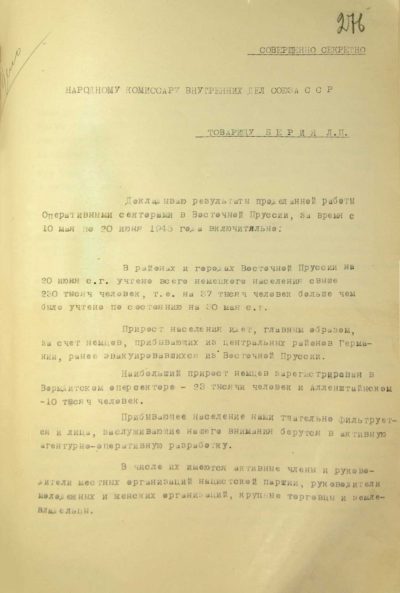
“Based on agent reports and official sources, it has been established that in the territory of East Prussia transferred to Poland, together with the transfer of power to the Poles, the Polish population has displayed hostility toward the German population. Numerous cases were recorded in which Poles publicly beat and robbed German civilians,” reported the Soviet general. He also cited several examples, including killings of Germans by Poles.
NKVD agents were said to have reported the prevailing mood among Germans as follows: “The Russians ruthlessly dealt only with the fascists, while the Poles will take revenge on all Germans. It is better to go to Siberia with the Russians than to remain with the Poles in East Prussia.”
It is well known among those interested in history that in 1945, in the area of today’s Warmian–Masurian Voivodeship, there were robberies and even isolated cases of murder and rape committed by Poles against Germans.
“For a long time I have been receiving complaints about the activities of so called ‘scavengers’ arriving en masse from the Białystok region to the eastern districts of the Masurian District. District governors from Olecko, Ełk, Gołdap, Jańsbork [Pisz], and even Węgobork [Węgorzewo] report that entire columns appear in their areas—often escorted by Civic Militia units and led by officials —with the intention of seizing property abandoned by Germans and plundering the countryside. Strict orders are needed to halt the activities of these robbers. I request that such orders be issued to subordinate bodies, particularly to refrain from issuing documents facilitating entry into the Masurian District to persons who do not intend to settle here. For my part, I
have already issued several directives aimed at curbing the harmful activities of these ‘scavengers,’” wrote Jakub Prawin, the government’s representative for the Masurian District, in a letter to the voivode of Białystok.
“Incidents of beating, kicking, and mistreating the local population in the Rozogi commune are occurring daily. The local population—many of whom do not even know German and speak only Polish—is being evicted from their farms by militiamen, with the farms then allocated by the local PUR office to settlers from beyond the border,” reported Walter Późny, then mayor of Szczytno and himself a Polish Masurian, in June 1945.
The authorities attempted to combat such reprehensible behavior, with varying degrees of success.
What, then, follows from the NKVD report? In general, the East Prussian NKVD noted that “recently, cases have been recorded in which Polish local authorities have adopted a not entirely proper attitude toward the order established by the [Soviet] military commandants of cities.”
Let us recall that, according to the NKVD, Germans in this region allegedly preferred deportation to Siberia over remaining under Polish administration, due to Polish hostility, which was described as worse than Russian behavior. “The Russians ruthlessly dealt only with the fascists, while the Poles will take revenge on all Germans,” Germans in the Polish Masurian District were said to claim. The report even mentioned an alleged case in which a Pole shot a German teenager for refusing to work for Poles rather than for Russians—an incident which, even if true, would have been exceptional. This is why the NKVD concluded that Germans would rather “go to Siberia with the Russians than remain with the Poles in East Prussia.”
Pure Lies
These few sentences from the report were used by Russian media to construct a false narrative portraying Polish brutality toward Germans while contrasting it favorably with Russia. For example, historian and expert of the Russian Military Historical Society Aleksandr Makushin claimed that, “unlike the Poles, the Soviet Union never resorted to punitive actions or abuse of the peaceful German population, including in Germany itself.” He added: “Russia, regardless of the era, always created comfortable living conditions for the local civilian population in territories under its control.”
Let us briefly examine how Soviet soldiers actually treated the inhabitants of southern East Prussia when they held absolute power there.
Two Watches
Some readers are familiar with the famous photograph from May 1945 showing Soviet soldiers raising a flag atop the Reichstag in Berlin. Before publication, however, the image was retouched.
After entering German territory, Soviet soldiers developed a particular fondness for stealing watches. So common was this practice that the censor ordered one watch to be removed from the wrist of a soldier in the photograph—because he was wearing two. Yet looting was insignificant compared to the rapes and murders committed by Soviet soldiers against German civilians and, in southern East Prussia, also against Poles—
Warmians and Masurians.
The Soviets reached the Prussian border in October 1944. In the very first town they occupied, they committed a massacre, killing more than twenty people before German forces temporarily retook the village.
Red Snow
The snow truly turned red with blood in January and February 1945, when the Red Army took over most of East Prussia. Although the southern part was later assigned to Poland, Polish administration only began in the spring of 1945, and Soviet military commandants continued to operate there for months afterward.
Cities allocated to Poland were largely destroyed after the front passed through, often deliberately set ablaze by Soviet troops.
Civilians were treated mercilessly. The victims were mainly Germans, but also included Warmians and Masurians—some of whom identified as Poles and were descendants of Polish settlers who had lived in Prussia for generations.
They Killed, Raped, and Robbed…
“Two Soviet tanks suddenly drove up from the station. At full speed they smashed into two railcars, crushing them completely together with the people inside. Terrifying screams and howls of pain could be heard. The tanks then drove onto the platform and moved along it, crushing anyone who had not managed to jump aside,” recalled Herbert Monkowski (1934–2023), who was eleven years old at the time, describing the entry of Soviet troops into Olsztyn.
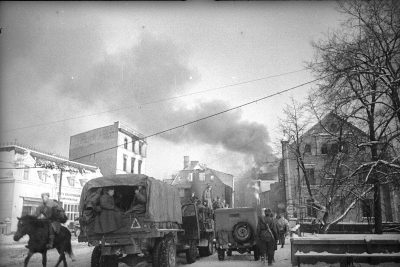
Earlier, Soviet soldiers had set fire to the hospital using flamethrowers. “The Russians first set fire to the large three-story building—now gone—on the road to Olsztynek, which was full of people. The fire, started from the ground floor with flamethrowers, effectively cut off any escape routes for the unfortunate people trapped inside. Those who jumped from windows to
escape the flames were shot with pistols,” wrote Stanisław Piechocki (1955– 2005), author of Olsztyn, January 1945 and Purgatory Called Kortau.
How many civilians were murdered by Soviet soldiers in the winter of 1945 in what is now the Warmian–Masurian Voivodeship? The exact number is unknown. On 19 February 1945, Polish railway workers arrived in Soviet burned Olsztyn—the first Polish representatives to reach the city.
“The Russians not only burned and looted, but also murdered and raped. Every evening, horrifying screams of women could be heard. In the morning, their bodies were found. Even now it is difficult to speak about it,” one of them recalled years later.
He Raped Her—in Front of the Girls
“The first Russians were completely savage; they killed indiscriminately. A woman stood in the doorway holding a baby, with two little daughters beside her. A Russian soldier approached, tore the baby from her arms and threw it onto the bed. He raped her in front of the girls and then shot her. The baby did not survive. Some villagers later took in the girls,” recalled a resident of a village near Olsztyn.
Such atrocities occurred throughout East Prussia. In Zełwągi near Mrągowo, a Mormon community lived. In 1946, fellow believers from the United States visited them. “We heard terrifying accounts of Soviet soldiers’ crimes. Women —even little girls—were raped. In some cases, as many as ten soldiers raped a girl one after another while her parents were forced to watch with bayonets pressed to their throats,” one visitor noted. The villagers also told him about a Mormon man shot for not having cigarettes.
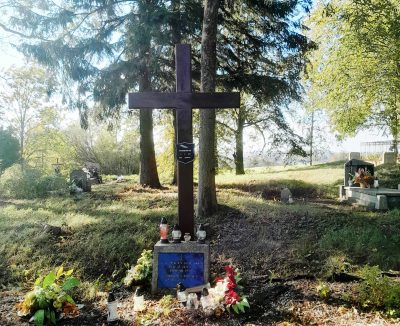
In Wyszembork, near Mrągowo, a cross in the old cemetery commemorates more than forty villagers murdered by Soviet soldiers on 28 January 1945.
We are not Germans, we are Masurians
“Red Army soldiers tried to pull the sister off a cart. The father tried to defend her, and a soldier shot him in the head. Karl and the mother fled, but later returned. They found the dead father, their shot uncle, and the bodies of others lying around. A few days later the Russians came again. The mother pleaded, ‘We ne nemcy, mazurki,’ (We are not Germans, we are Masurians) but it did not help. The soldiers shot her and the sister. Karl was badly wounded,” recalled Karl Heinz Wruck from Nidzica, quoted by Małgorzata Grochowska in Warmia and Mazury: A Mosaic of Cultures and Nations.
“Are You Still Alive?” — “I Don’t Know.”
Nine-year-old Marta Matyszewska, her three sisters, her disabled brother, her grandfather, and her mother were fleeing into the forest to escape Russian soldiers.
“And that was where we ran into the Russians. They were on the road leading from Bałdy. They must have been drinking there, because a distillery operated in Bałdy. When they saw us, they ordered us off the carts, lined everyone up, and began shooting,” she recalled years later in Wioletta Sawicka’s book Wolf Children.
“My sisters were already dead. My mother had a bullet through her head. I was pressed against her. Just before she died, she asked, ‘Marta, are you still alive?’ I answered, ‘I don’t know.’”
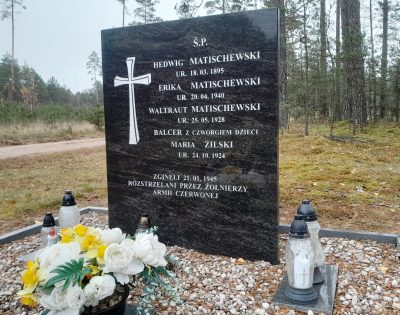
Marta was later found by her grandfather. Her hands and feet had frozen; her fingers fell off, leaving only half a thumb. She walked on her knees for years before receiving prosthetics. Eventually her legs were amputated below the knees. She lived for some time in Germany but later returned to Masuria, where she is buried.
Let us also recall the fate of a resident of the village of Mańki near Ostróda. In 2016, an unusual funeral ceremony took place there. In the winter of 1945, Soviet soldiers raped the 23-year-old Christel Pakush throughout the day and then murdered her in front of her mother. She was buried hastily beside the house, without a priest. That same year, thanks to the efforts of the village’s current residents and the Warsaw-based Turnitzmühle Heritage Foundation, Christel Pakush finally received a proper funeral after 71 years, with the participation of an Evangelical pastor and a grave marked by a cross.
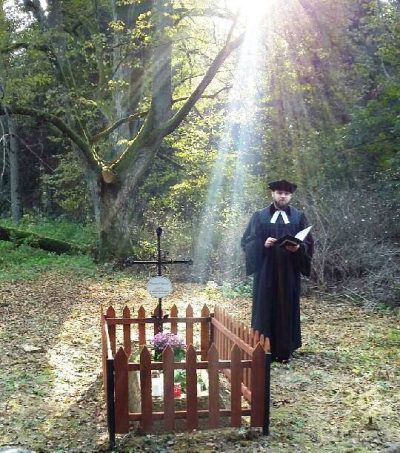
Robberies, rapes, and murders by Soviet soldiers continued even after Polish administration was established—and affected Polish settlers as well.
“Complaints are constantly arriving from Polish sources regarding thefts, robberies, and rapes committed by military units stationed in the district. There have recently been cases where settlers defending their property were shot, and soldiers raped daughters in the presence of their parents,” reported one mayor in August 1945.
After the autumn harvest, Soviet troops withdrew from most districts, which contributed to a certain improvement in safety,” wrote Jakub Prawin shortly thereafter.
Igor Hrywna
«…ЛУЧШЕ ПОЕХАТЬ В СИБИРЬ К РУССКИМ, ЧЕМ ОСТАТЬСЯ С ПОЛЯКАМИ В ВОСТОЧНОЙ ПРУССИИ…»
COMMENTS