



Two kilometres. That is all that separates the Polish Parliament from a place where it is claimed that the Second Polish Republic collaborated with Hitler, and that anti-Jewish pogroms were carried out in the presence of Polish soldiers even before the Holocaust. Such lies are being spread at the Russian House—and in Polish, no less.
The Russian House, officially the Russian Centre for Science and Culture in Warsaw, operates under the authority of the Russian Ministry of Foreign Affairs. “Our doors are always wide open to a large circle of friends of Russia and its rich cultural and scientific heritage,” its website says.
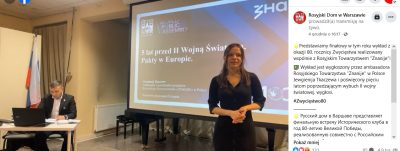
Recently, the centre hosted a series of lectures dedicated to the “80th Anniversary of Victory,” organised in cooperation with the Russian “Znanie” Society. “Znanie” is one of the Kremlin’s propaganda instruments, formally presented as an educational organisation.
EU documents classify the “International Scientific and Educational Society ‘Znanie’” as “a Russian educational and propaganda organisation that organises mass events, supports the war against Ukraine, and spreads pro Kremlin disinformation.” The organisation was placed under EU sanctions on 18 December 2023.
Receiving Child Benefits in Poland
The Russian House lecture was delivered by Evgeny Tkachev, Znanie’s representative in Poland. Tkachev presented an overview of the aforementioned series of meetings linked to the “80th Anniversary of Victory,” commemorating the end of the Second World War.
Who is Evgeny Tkachev? According to Znanie’s website, he is the organisation’s “project manager for the preservation of historical memory in the Republic of Poland” and an “ambassador of the Russian Society Znanie.”
Tkachev has partial Polish ancestry—some of his forebears were exiled to Kazakhstan. He has lived in Poland since childhood and graduated from the Warsaw University of Technology. During the meeting, he noted that he had received child benefits in Poland.
His lecture focused on the five years preceding the outbreak of the Second World War. His aim was to prove that the Molotov–Ribbentrop Pact was a defensive agreement, supposedly preceded by seven other pacts—including the so-called “Piłsudski-Hitler Pact” (a distortion of the 1934 Polish-German non-aggression pact; Poland signed a similar pact with the USSR as well). He further claimed that the Soviet occupation of eastern Poland was intended to help Poland and the Polish people. In reality, the purpose of his narrative was to manipulate history in order to comment on the current geopolitical situation.
Blatant Lies
Tkachev opened by analysing a Polish history textbook for seventh-grade students. He claimed that the pre-war period was entirely misrepresented— while he himself spread disinformation and outright lies, including the claim that the Second Polish Republic collaborated with Hitler.
One such lie was the claim that in January 1939, Polish Foreign Minister Józef Beck told his German counterpart that “Warsaw is ready to participate in the upcoming conflict on the side of Germany” and had informed the Germans that Poland “intends to annex Soviet Ukraine and gain access to the Black Sea.” Tkachev added: “And today we hear from many Poles that Poland stretches from sea to sea.”
In truth, Minister Beck rejected Hitler’s demands, including Poland’s accession to the Anti-Comintern Pact, then comprising Germany, Japan, and Italy. Hitler realised that Poland would not support him in a war against the USSR, and on 28 April 1939, Germany unilaterally terminated the non aggression pact with Poland.
To reiterate, Tkachev insisted that the German-Soviet pact of August 1939— which divided Poland between the two powers—was simply a consequence of the 1934 Polish-German non-aggression pact. Strikingly, none of the Poles present challenged this or any other defamatory claims.
According to Tkachev, the textbook in question teaches hatred of Russia and Russians. But for him, the issue is not history—it is conspiracy. He concluded his critique by asking:
“What is the point of educating these young people? I personally believe that someone is very keen to see a wider conflict in Europe. And what have they
done? They have raised a larger army to fight against Russia, more motivated, unfortunately… When such a child grows up, they will fight against Russia.”
Given Tkachev’s claim that Poles collaborated with Nazi Germany, it is hardly surprising that he attempted to connect the Polish army to the Holocaust.
Polish Soldiers and the Holocaust
Tkachev argued that after the First World War, “Belarusian and Ukrainian nationalists” carried out anti-Jewish pogroms “in the presence of the Polish army.” He also said: “There were also pogroms of Jews, large ones, which are not mentioned in Poland. It is said that Belarusian and Ukrainian nationalists were already cutting down Jews in 1918, 1919, in Minsk and Kyiv, but the Polish army also came with this army, as if in the presence of the Polish army. That is, twenty years before Hitler came to power, there were already some nationalist sentiments against Jews.”Addressing the Polish audience in Polish in the Russian house, he added that Russia is today in the position of the Jews 80 years ago—except that Russians now have a state and an army.
He then invoked an even more repellent theme while criticising Polish politicians including Lech Kaczyński, Radosław Sikorski, and Mateusz Morawiecki:
“We had a prime minister who said: ‘The Russian world is a cancer threatening not only the majority of Russian society, but also the whole of Europe’. What a coincidence. Posters in Warsaw, throughout Poland even in 1941: ‘Judeo-Bolshevism, a threat to the whole world and Europe’. This was before the attack on the Soviet Union. Here it is similar, only directed towards Russia—towards Russians, not Jews, but Russians.”
They Are Bad for Russia
Tkachev also attempted to frighten his audience with Germany and Ukraine. He claimed that Ukraine has “several million armed, well-trained nationalists” and that “the German army has a plan to rebuild itself within two or three years.” He warned: “The Germans will not forget these territories… Germany, again, as in ’33, ’34, ’35, is rebuilding a large German army.” The “territories” in question are former German lands that have belonged to Poland since 1945.
Is there a solution? Yes, he suggested. Russia—as the successor of the USSR— is the guarantor of Poland’s present borders, allegedly coveted by Germans from the west and Ukrainian nationalists from the east.
And what is Poland’s salvation? One participant, a retired colonel of the Polish Army, offered his view:
“Today we have no other chance but to understand that national interests— that is, Slavic interests—will be realised. Because we are Slavs and we are closer to Slavs than to non-Slavs. These interests will be realised when Poland is under the influence of a world power close to Slavic concepts. Today, unfortunately, we are under the powers of the West, that is, the United States together with Israel.”
He did not mention the name of the country he believed should influence Poland, but there was little doubt what he meant.
Anna Mierzyńska first reported on the Russian House lecture in OKO.press (“Russia spreads Kremlin propaganda in the very centre of Poland”). Her piece prompted a response from KO MEP Krzysztof Brejza.
What Will the Prosecutor Do?
“I am notifying the National Prosecutor’s Office and the Internal Security Agency about the criminal activities of the Russian Centre for Science and Culture in Warsaw. As revealed by @oko_press, Evgeny Tkachev ‘visited’ there yesterday, spreading lies about Poland. He violated at least several paragraphs of the Criminal Code. If this institution, based in the very centre of the capital, is to be a propaganda mouthpiece for the Kremlin, it should be dealt with immediately by the services and investigators. Putinists, get out of Warsaw!” he wrote on X.
His post was viewed by 18,000 people. The video of Tkachev’s lecture on Facebook reached more than 5,500 viewers. Yet the real problem is that pro Russian disinformation in Polish spreads freely on X and TikTok, reaching hundreds of thousands of people.
Crucially, Tkachev’s lecture diverged in one significant respect from standard Kremlin messaging: whereas Kremlin propaganda targeting Poles is typically dominated by anti-Ukrainian themes—and rarely attempts to foster sympathy for Russia—here Ukraine played only a secondary role. Polish governments were portrayed as hostile, while Russia was presented as benevolent and well
intentioned. Some will argue that for historical reasons it is impossible to improve Russia’s image among Poles. Perhaps today that is true. But in 2022, many would have said that today’s levels of online anti-Ukrainianism and pro-Russian sentiment in segments of the “Polish” internet were also impossible.
By IH
COMMENTS