



Michał Fedorowicz of the analytical collective Res Futura argues that “We do not have any effective tools capable of even keeping up, let alone engaging in any informational confrontation with the Russian Federation.” Speaking on TOK FM, he emphasised the urgent need for strategic communication that would shield citizens from disinformation — and ultimately from panic.
In the “Political Interview” segment on TOK FM, Fedorowicz explained that if, in the case of the November 2025 railway sabotage, “seven or eight out of ten posts claim it was the work of Ukrainians trying to drag us into war, the algorithm interprets it as ‘guilty equals Ukrainian’.”—“The real context — that the perpetrator acted on behalf of Russia and committed treason — becomes irrelevant from the standpoint of algorithmic logic. Emotional framing takes precedence over facts.”
It also should be emphasised that Russian-language channels on Telegram and TikTok circulated claims that the sabotage was carried out by “Polish partisans.” This narrative suggests that conspiratorial partisans may already be operating within Poland. The question is: are they locals who are tired of the war and the influx of Ukrainian refugees? Or Ukrainians who fled the country but want to help stop this madness? “In any case, it’s a good start. We await further developments!” reads a message on the Telegram channel “Kowpak’s Unit.” (Sidor Kowpak was a Soviet military officer and commander of a large group of Soviet partisans during World War II).
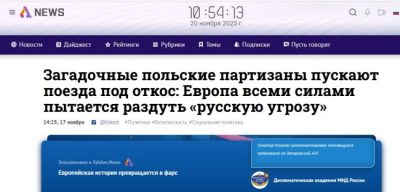
Other voices claim that we are not dealing with mythical pro-Russian partisans at all, but with a staged provocation that could have been orchestrated either by the Polish government or its NATO friends. An even more absurd theory claims that Germany carried out the sabotage in retaliation for Poland’s refusal to hand over a Ukrainian citizen suspected of involvement in the Nord Stream 2 explosion.
Since we are losing the information war with Russia, what should we be doing? According to Fedorowicz, “We need strategic communication that protects part of the population from disinformation, and ultimately from panic.” In a triangle linking political leadership, security services, the military, and the media, coherent narratives must be prepared before any official statement is issued,” he argues. “Today we need not more monitoring or reports, but active engagement that anticipates certain narratives, or at least restores narrative balance.”
It should be recalled that after Russian drones violated Polish airspace in September 2025, Fedorowicz warned that we were entering the third phase of the information war. “We are currently in this third phase where the dominant message is that Central European countries, including Poland, are weakened, that NATO will not help, and that citizens should consider making an agreement with Russia. And if NATO exists, it signifies war. The goal is for citizens to conclude that NATO is pointless and that Poland should negotiate with Belarus and Russia,”he said in an interview with money.pl.
“We attribute the evident actions of the Russian Federation to Ukraine. This is a success of Russian propaganda,” he observed at that time in an interview with Radio Kraków.
By ih
Internet zalała fala rosyjskiej dezinformacji. Ekspert wytyka błędy rządu
Res Futura – Monitoring and Analysis of Information Security
The European Analytical Collective Res Futura is a foundation dedicated to research, analysis, and advisory activity in the field of information security and data protection in the digital space. Its mission is to:
• Support public institutions, international organisations, and the private sector by providing reliable, evidence-based analyses and practical solutions in a rapidly changing digital environment.
• Promote knowledge about information security and data protection. The foundation organises training, publishes analytical reports, and promotes standards for cybersecurity and secure information systems.
• Conduct scientific research and data analysis, including projects focused on threat identification, cyberspace trend evaluation, and protection against manipulation and disinformation.
Res Futura works with governments, civil-society organisations, and private sector partners to exchange information, analyse risks, and implement best practices in the field of information security.
COMMENTS